

From Land to Sea: How Evolution Really Works


🔹 Warm-up — Thinking About Change and Life
Before we talk about whales, let’s think about life and change.
Do species stay the same forever, or do they change over time?
Why do some animals survive in difficult environments while others disappear?
If an environment changes slowly, do you think animals can change with it?
Many people imagine evolution as something fast or dramatic. But evolution is not about sudden transformation. It is about small differences, repetition, and time. To understand whale evolution, we first need to understand how evolution actually works.
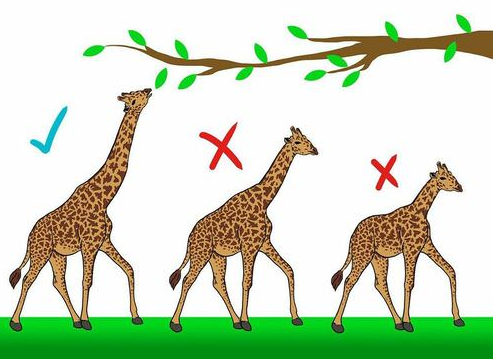
Passage 1 — How Evolution Happens
Evolution happens through reproduction. When animals reproduce, their offspring are not exactly the same as their parents. Sometimes, small mutations appear naturally. These mutations are not planned, and most of them do nothing important. However, some mutations can help an animal survive better in a specific environment.
When an animal has a characteristic that helps it survive, it usually lives longer and reproduces more. This means it passes its genes to the next generation more often. Over many generations, these helpful genes become more common in the population. This process is called natural selection.
Nature does not choose consciously. The environment creates pressure. Animals that are better adapted to that environment survive and reproduce more. Little by little, the species begins to change. This is why evolution is slow and continuous.
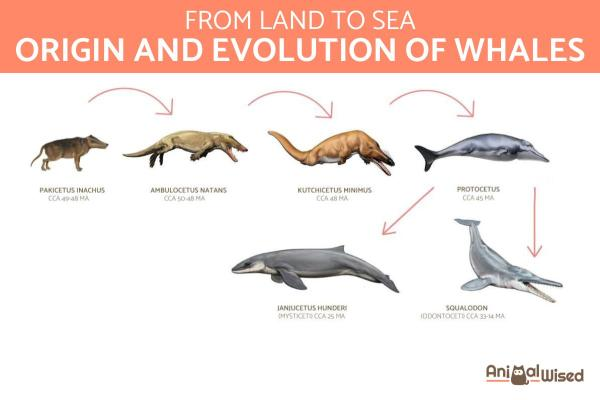
Passage 2 — Pakicetus and the Origin of Whales
Millions of years ago, whales did not live in the ocean. One of their ancestors was an animal called Pakicetus. It lived on land but stayed close to water, especially rivers and coastal areas. Water offered food and safety, so animals that could swim better had an advantage.
Some Pakicetus offspring were slightly better swimmers than others. These animals survived more easily near water and reproduced more. As generations passed, their descendants inherited traits that helped them live in water. Legs slowly became less important, bodies became more suited for swimming, and movement in water became easier.
This did not happen because the animal wanted to change. It happened because animals with traits that worked better in water survived more often. Over millions of years, these small changes accumulated, and land animals slowly became fully aquatic animals: whales.
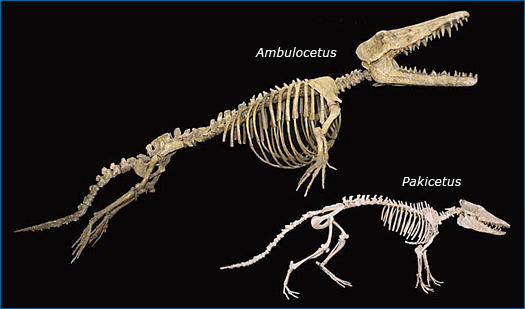
Passage 3 — Evidence and Living Examples Today
Scientists know this process happened because of fossils, bone structure, and genetics. Fossils show animals with mixed characteristics: land mammals with features that later appeared in whales. Modern whales still have small internal bones that come from land ancestors, even though they no longer use them.
This process is not only something from the past. Evolution is happening right now. Some animals today live both on land and in water. Hippos spend most of their time in water but still walk on land. Otters are excellent swimmers but depend on land to rest and reproduce.
If environments continue to change, these animals may also change slowly over time. The same mechanisms are still working: reproduction, mutation, selection, and time.
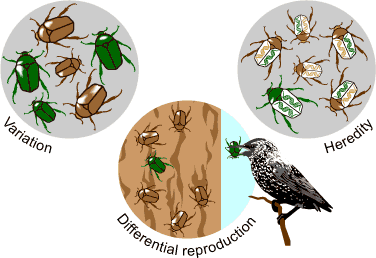
Passage 4 — How a Trait Becomes Common in a Species
When animals reproduce, each baby is born with DNA that is slightly different from its parents. These differences happen naturally and randomly. Most of the time, they do not change much. But sometimes, a difference helps the animal survive better in its environment.
If that animal survives longer and has more offspring, it passes this helpful DNA to the next generation. When this happens again and again, the trait becomes more common in the population. Over time, what was once rare can become normal.
This is how a characteristic becomes predominant in a species. It is not sudden, and it is not intentional. It is the result of many generations repeating the same process: reproduction, survival, and transmission of genes.
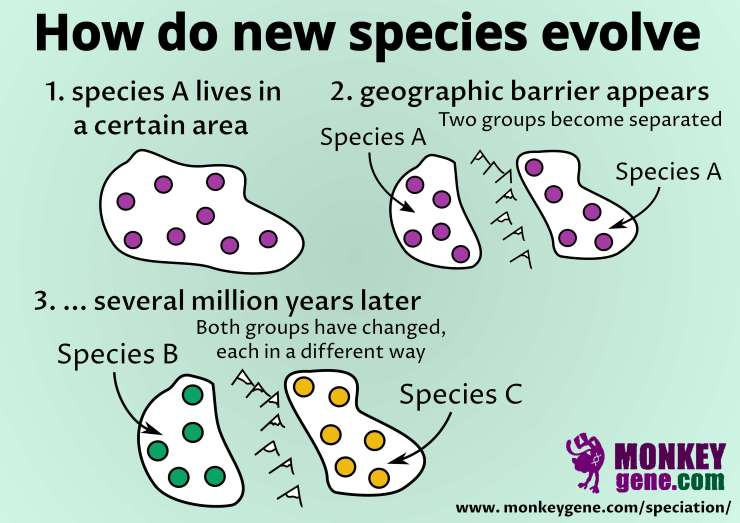
Passage 5 — How New Species Appear
A new species can appear when a group of animals becomes isolated from the rest. This isolation can happen because of geography, climate, or behavior. When animals stop reproducing with the original group, their genetic differences slowly increase.
Over a long period of time, these differences become so large that the two groups can no longer reproduce together. At this point, scientists consider them different species. This process is called speciation.
New species can also appear when a mutation creates a major advantage and spreads through a population. In both cases, the key elements are the same: time, reproduction, and environmental pressure.
🔹 Final Reflection — Speaking & Writing Task
Now let’s organize your ideas and reflect on what you learned.
Writing Task (guided and chronological):
In your text, try to follow this order:
First, explain what evolution is in your own words.
Then, say what you think about evolution. Do you find it convincing or surprising? Why?
After that, explain what you liked the most about this lesson and why it caught your attention.
Next, choose one or two animals that you think are currently in an evolutionary process. Explain why you chose them.
Finally, imagine what might happen to these animals in the future if their environment continues to change.
You can use examples like hippos, otters, seals, or any other animal you find interesting.
As most people know, evolution can be defined as a scientific process that happens with all the living beings. It isn’t an optional change, it’s a survival necessity. As time goes, enviroment pressures species to adapt, so the natural selection can happen.
When a gene helps a species to survive it’s more likely that it will be passed through the next generations, creating new species and making others disappear. But how can we affirm that this process actually happens? According to science, we can say that this process is actually true due to paleontology and genetics. Fossils show similarities between the current animals and their ancestors because most of them preserve their ancient structures like whales, who still have a small bone that used to be their legs.
What mostly caught my attention is that the evolutionary process is really visible on our daily lives. Many animals are still transitioning. Some examples are manatees, otters and buffalos.
When it comes to evolution, we can see that it is a very important process to explain the origin of the living beings and how they changed through time. This process is directly associated with the mutations that occasionally occur with reproduction and little by little make ancestor species become new ones. Evolution can be proved through material proofs, like fossils, and by scientific studies of the anatomical and genetic similarities between the modern species and between them and their ancestors. This process depends on a lot of factors, such as natural pressure and genetic phenomenons. At the end of the day, evolution is a scientifically comproved process that explains a lot about the origin of life and the world itself.
In fact, evolution is a process that animals have to do to survive in specific environments in which they would not be able to survive otherwise. Getting new “skills” and characteristics through the generations allows them to be able to survive. In fact, I really like the evolutionary process, because I think it’s so interesting and important for science and studies in general. Also, with the many climate changes that we have today, it’s very important for a lot of animals to perform the evolutionary process, because they really need to develop their genes and characteristics to survive. For all these reasons, I really think that evolution is a very powerful mechanism of nature to improve the species and adapt them to the environmental changes.